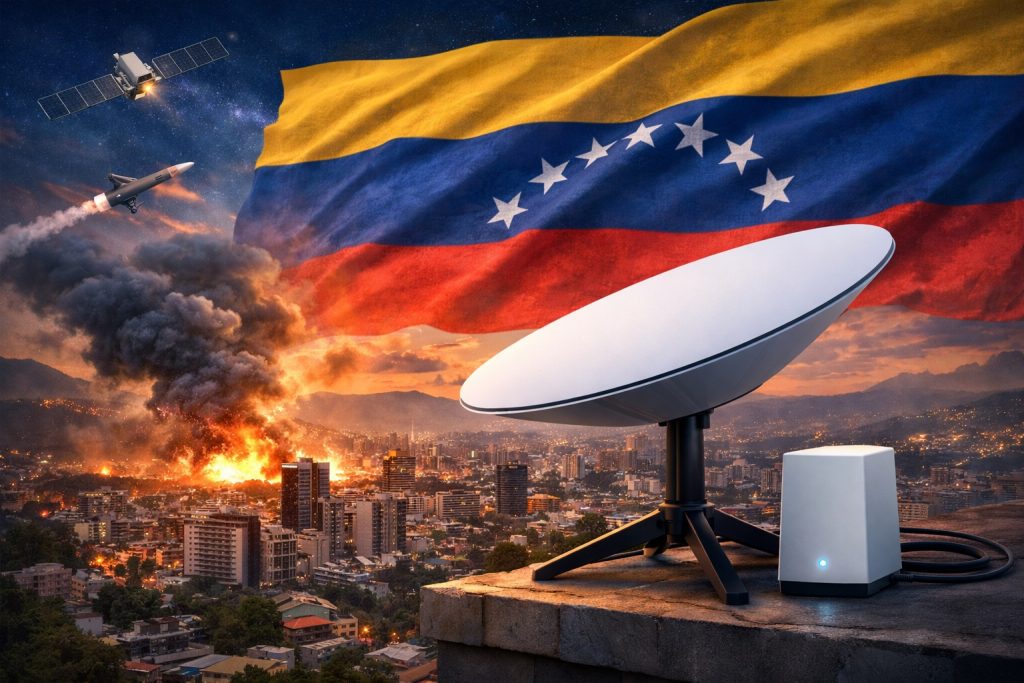
Elon Musk’s Starlink has begun offering free broadband internet access to users in Venezuela through February 3, following recent U.S. airstrikes and the arrest of former leader Nicolás Maduro.
In a statement released Sunday, the satellite internet provider said it is adding service credits to both active and inactive accounts while closely monitoring the evolving situation in the country. Starlink, a SpaceX subsidiary, delivers internet via low-Earth-orbit satellites, though users must purchase separate hardware to access the service.
Although Starlink’s official availability map still lists Venezuela as “coming soon,” the company noted that users can currently connect through its roaming plan. Starlink added that it does not yet have a timeline for local hardware sales, and any updates would be shared through official channels. It also remains unclear how service availability and pricing may change after February 3, particularly as the company has not announced plans to distribute hardware kits within Venezuela.
In the U.S., Starlink’s Roam plan starts at $50 per month, with standard hardware priced at $279, though costs may vary by region.
The announcement comes amid widespread disruption following U.S. military operations on January 3, which reportedly targeted areas in Caracas as well as the states of Miranda, Aragua, and La Guaira. Local media have reported power and internet outages in parts of the capital and neighboring regions.
U.S. President Donald Trump has said Washington will oversee Venezuela’s political transition, though details remain unclear. He also confirmed that Vice President Delcy Rodríguez was sworn in after Maduro’s arrest and warned of further military action if the new leadership fails to cooperate.
Starlink’s expanding role
Venezuela is not the first conflict-affected region where Starlink has been deployed. The service was introduced in Ukraine in 2022 after Russia’s invasion damaged critical communications infrastructure, becoming an essential tool for both civilian and military connectivity.
While widely praised, Starlink’s use in Ukraine also sparked debate over the power a private company can wield during wartime. Those concerns intensified in 2023 after reports revealed Musk had previously declined a request to activate coverage over Russian-controlled Crimea, leading to scrutiny from U.S. lawmakers. The issue was later addressed when the U.S. Department of Defense brought Starlink’s Ukraine operations under formal oversight through a contract with SpaceX.
Beyond war zones, Starlink has also been used to bypass government-imposed internet shutdowns and censorship. In Iran, thousands have reportedly relied on the service to access uncensored information, despite it not being officially authorized. Venezuela itself has a long history of internet restrictions during periods of political unrest.
“Starlink allows internet access to be provided by non-state companies in authoritarian regimes,” said Marko Papic, Global GeoMacro Strategist at BCA Research, noting that this trend is likely to expand in regions where the U.S. has tense relations with local governments.
At the same time, concerns over U.S. dominance in satellite broadband have prompted other governments to invest in domestic alternatives. China, for example, has launched more than 100 low-Earth-orbit satellites under projects such as Qianfan and Guowang, while the European Union continues to support its own satellite initiatives.
Source: cnbc Edited by Bernie