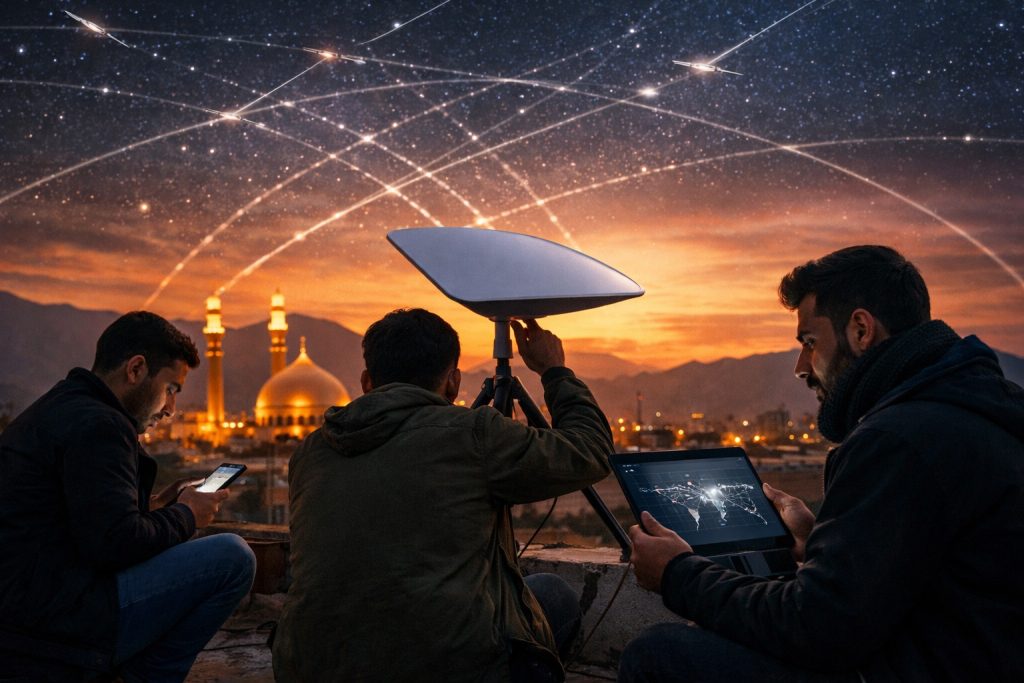
Some Iranians are continuing to access Elon Musk’s Starlink satellite internet service despite a near-total nationwide communications blackout, according to three people inside the country—highlighting once again how the technology is being used to circumvent internet shutdowns during geopolitical crises.
Iranian authorities have in recent days launched a deadly crackdown on nationwide protests, accompanied by an almost complete shutdown of conventional internet services delivered via fiber-optic networks and mobile towers. However, Starlink—which delivers connectivity directly from thousands of low-Earth orbit satellites—remains operational in parts of the country, even though it is banned by Iranian authorities.
Three Starlink users inside Iran told Reuters the service is still functioning, particularly in border towns and some cities. One user in western Iran said he knew dozens of people using Starlink and that connectivity in those areas appeared largely unaffected.
Alp Toker, founder of internet monitoring group NetBlocks, said he has also received reports indicating that Starlink access persists in Iran, though at reduced levels. “It is patchy, but still there,” he said.
Toker added that a broader internet blackout that began on January 8 continued on Monday, with non-satellite internet connectivity operating at roughly 1% of normal levels, based on NetBlocks’ fixed-line and mobile data.
While it remains unclear how Iranian authorities are attempting to disrupt Starlink, some experts suggest signal jamming may be interfering with terminals by overwhelming their ability to receive satellite transmissions.
Starlink, a unit of U.S.-based SpaceX, did not respond to requests for comment. Iranian authorities were also unreachable due to ongoing phone and internet outages. The government has blamed the unrest on terrorists and pledged to protect the ruling system.
Critical Tool in Global Conflicts
Starlink’s role as a communications lifeline for some protesters in Iran underscores the growing influence of Musk’s satellite internet service in conflicts and periods of unrest worldwide.
The system has been a critical asset for Ukrainian forces since Russia’s full-scale invasion in 2022. In Myanmar, where the military junta has repeatedly shut down internet access, rebel groups, humanitarian organizations, and medics have relied on Starlink. In Sudan, the service has been used by both sides in a prolonged civil war amid persistent blackouts.
U.S. President Donald Trump said on Sunday that he plans to speak with Musk about restoring internet access in Iran, though he did not explicitly mention Starlink.
Musk previously sent free Starlink terminals—roughly the size of a laptop—to Ukraine and provided complimentary service. Standard terminals typically cost about $599, plus a monthly subscription fee, placing them out of reach for many Iranians.
Musk’s ability to influence conflict dynamics was highlighted in 2022, when he restricted Starlink access as Ukrainian forces advanced into Russian-held territory, Reuters has reported.
Although Starlink is not licensed to operate in Iran, Musk has said the service is active there. In December 2022, he wrote on X that the company was “approaching 100 Starlinks active in Iran,” a small number relative to the country’s population of 92 million. In June last year, responding to calls for expanded access, Musk posted: “Beams are on.”
Following a 12-day war between Iran and Israel in June, Iran’s parliament passed legislation formally banning Starlink use and imposing severe penalties for those who use or distribute the unlicensed technology, according to state media.
Source: Reuters Edited By Bernie