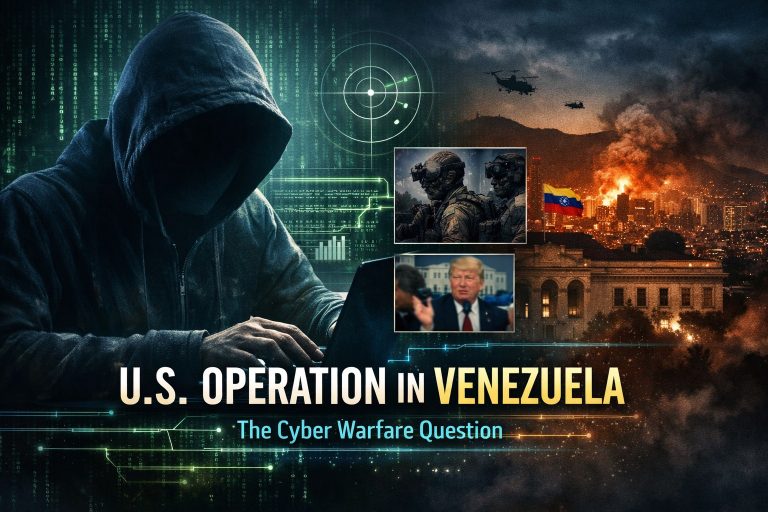
The extent to which cyber operations played a role in the recent U.S. military raid in Venezuela remains uncertain, despite remarks by President Donald Trump suggesting that specialized capabilities were used to disable power in Caracas.
The operation, which resulted in the capture of Venezuelan President Nicolás Maduro, reportedly involved “layering effects” from U.S. Cyber Command and other federal agencies. However, experts say there is no definitive evidence confirming that cyberattacks were a decisive element of the mission.
Speaking at a Jan. 3 press conference following the operation, Trump hinted at advanced technical capabilities used during the raid. “It was dark — the lights of Caracas were largely turned off due to a certain expertise that we have,” he told reporters. His comments quickly fueled speculation that U.S. cyber forces were responsible for a blackout in the Venezuelan capital.
While monitoring organization NetBlocks recorded a drop in internet connectivity in parts of Caracas that coincided with the operation, the cause of the outage remains ambiguous. Alp Toker, director of the digital rights and internet governance group NetBlocks, cautioned against attributing the disruption to cyber activity alone.
“Our telemetry from Caracas that night does not indicate the use of any specific cyber capability,” Toker said. “The timing and location align closely with kinetic military activity, which typically suggests that physical explosions caused telecommunications failures, not the other way around.”
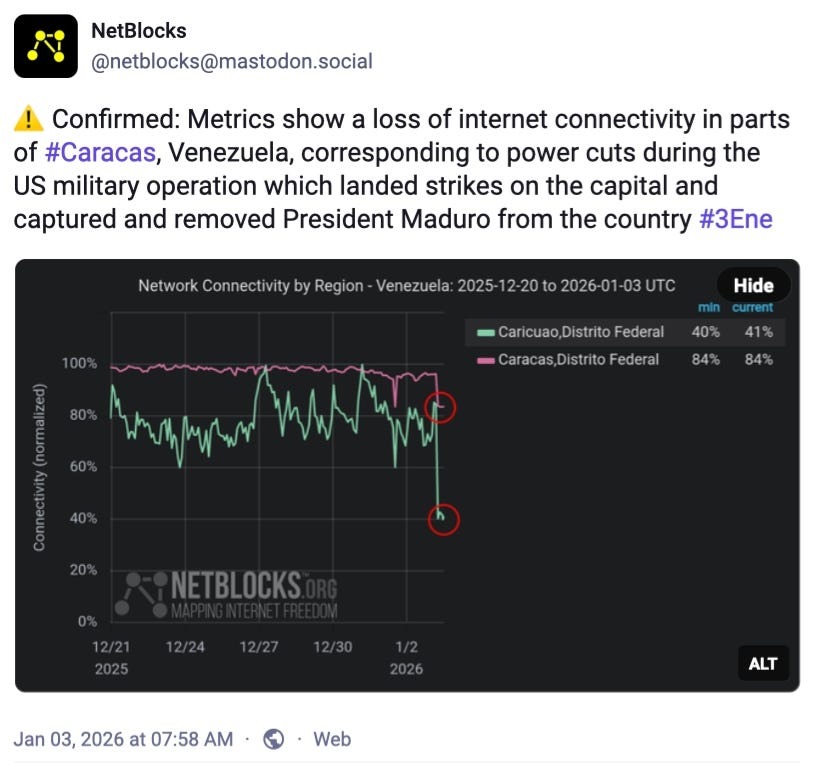
On Jan. 3, Venezuela suffered significant network degradation. Source: NetBlocks
Venezuela experienced significant network degradation on Jan. 3, but experts stress that such outages could just as easily result from electronic warfare or conventional attacks.
The U.S. has a long history of offensive cyber operations, though it often downplays or delays public acknowledgment. In 2010, the U.S. and Israel deployed the Stuxnet malware to disrupt Iran’s nuclear enrichment program, disabling roughly 1,000 centrifuges. The operation, known internally as “Olympic Games,” was later confirmed by senior U.S. officials.
More recently, U.S. cyber forces have disrupted ISIS media networks under Operation Glowing Symphony, targeted Russia’s Internet Research Agency during the 2018 midterm elections, and interfered with Iranian networks involved in attacks on oil tankers in the Persian Gulf.
According to Gen. Dan Caine, chair of the Joint Chiefs of Staff, multiple agencies—including the CIA, NSA, and U.S. Cyber Command—participated in the Venezuela operation. While he confirmed their involvement, he offered few specifics.
“As they approached Venezuelan shores, the United States began layering different effects provided by SPACECOM, CYBERCOM, and other interagency partners to create a pathway,” Caine said.
Adam Segal, director of the Digital and Cyberspace Policy Program at the Council on Foreign Relations, noted that if cyber capabilities were used, they were likely integrated with broader military actions.
“If it was cyber, it suggests a significant use tied to special operations,” Segal said. “Historically, these efforts tend to accompany kinetic attacks, as we’ve seen in places like Ukraine.”
Experts also point out that Venezuela’s digital and power infrastructure is particularly vulnerable. Much of the country’s critical systems rely on outdated technology developed before Hugo Chávez came to power, making them easier to understand and exploit.
“The blueprints, equipment lists, and technical expertise are widely available,” Toker said. “This isn’t Iran or Iraq. Venezuela’s infrastructure is fragile.”
Years of neglect have compounded the problem, with power and telecommunications failures frequently cascading from minor incidents. While conditions have improved slightly in recent years, analysts say the systems remain highly unstable.
In past incidents, Venezuelan authorities have blamed cyberattacks for disruptions, including delays during national elections. Although cybersecurity firms confirmed some attacks, they were unable to determine whether those incidents alone caused the outages.
Whether cyber operations were central to the U.S. raid in Caracas remains unresolved. Still, experts agree that cyber tools are likely to play an expanding role as the situation in Venezuela evolves.
“It’s difficult to say how critical cyber was in the initial operation,” Toker said. “But there’s little doubt it will become increasingly important. The vulnerabilities exist, and Venezuela presents a prime testing ground for cyber capabilities in modern military and nation-building efforts.”
Source: Darkreading.com Edited by Bernie