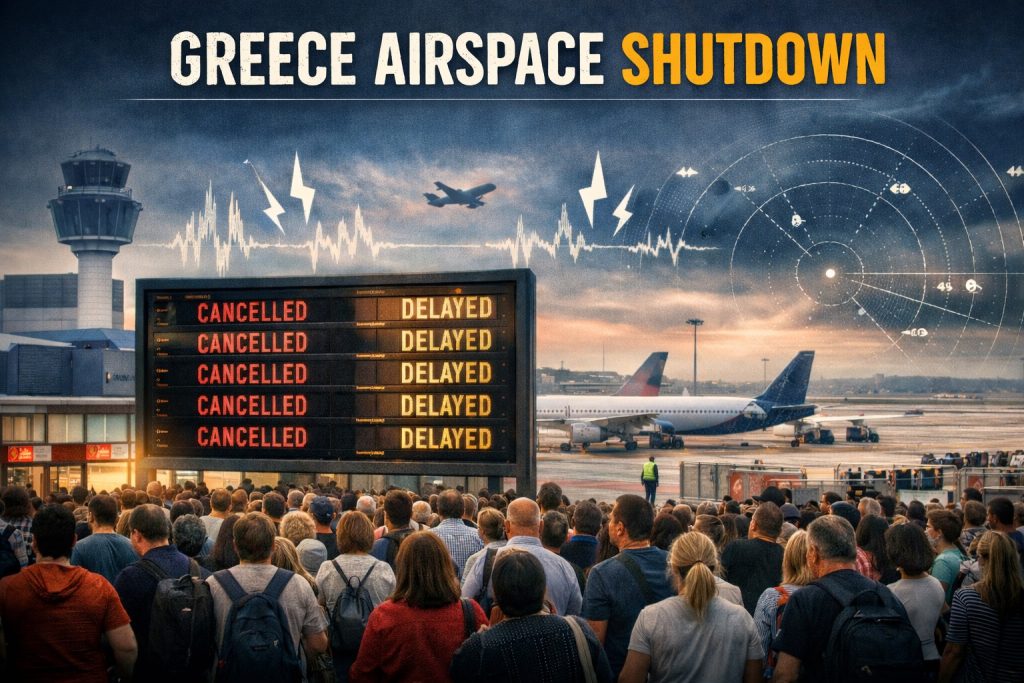
Greece was forced to shut down its airspace for several hours on January 4, 2026, after severe radio interference crippled air traffic control operations in Athens, disrupting hundreds of flights and stranding thousands of passengers.
The unprecedented technical failure began at 8:59 a.m. local time, when persistent “noise” flooded multiple radio frequencies used by controllers in the Athens Flight Information Region (FIR), cutting off voice communication between pilots and air traffic control. While radar systems remained operational, controllers could see aircraft but were unable to issue instructions or hear pilots, effectively leaving planes “flying deaf” for nearly four hours.
Departures were halted nationwide, incoming flights were diverted or held in neighboring countries, and overflights were managed under strict limitations. At Athens International Airport, security checkpoints closed as long queues formed, adding to widespread disruption. The airport handled more than 280,000 flights and nearly 34 million passengers last year.
Technicians rushed to relay stations in mountainous areas around Athens to trace the fault as safety protocols were activated. Officials stressed that safety was never compromised, noting that the airspace was cleared quickly and pilots retained essential navigation tools. Communications gradually stabilized, with full operations restored by 5 p.m. local time and normal flights resuming shortly afterward.
Authorities ruled out cyberattacks, sabotage, or external interference following initial speculation. Investigators instead pointed to Greece’s aging, largely analog communications infrastructure — some equipment dating back to 1999 — as the root cause. Experts said the outdated systems, while once reliable, are increasingly prone to failure and difficult to maintain due to scarce replacement parts.
A government-appointed committee is expected to release its findings soon, as a €300 million ($350 million) modernization program, including new digital transmitters, moves toward completion later this year. Junior Transport Minister Konstantinos Kyranakis acknowledged that upgrades should have been carried out “decades ago,” citing frequent leadership changes within the transport ministry.
Air traffic controllers’ unions described the shutdown as a predictable outcome of chronic underinvestment, staffing shortages, and obsolete equipment, warning that the risks are even greater during peak summer months, when up to 5,000 flights cross Greek airspace daily.
The incident has reignited broader criticism of Greece’s infrastructure management, drawing comparisons to the 2023 Tempi rail disaster that killed 57 people and triggered nationwide protests over systemic neglect.
Source: Greekcitytimes Edited by Bernie