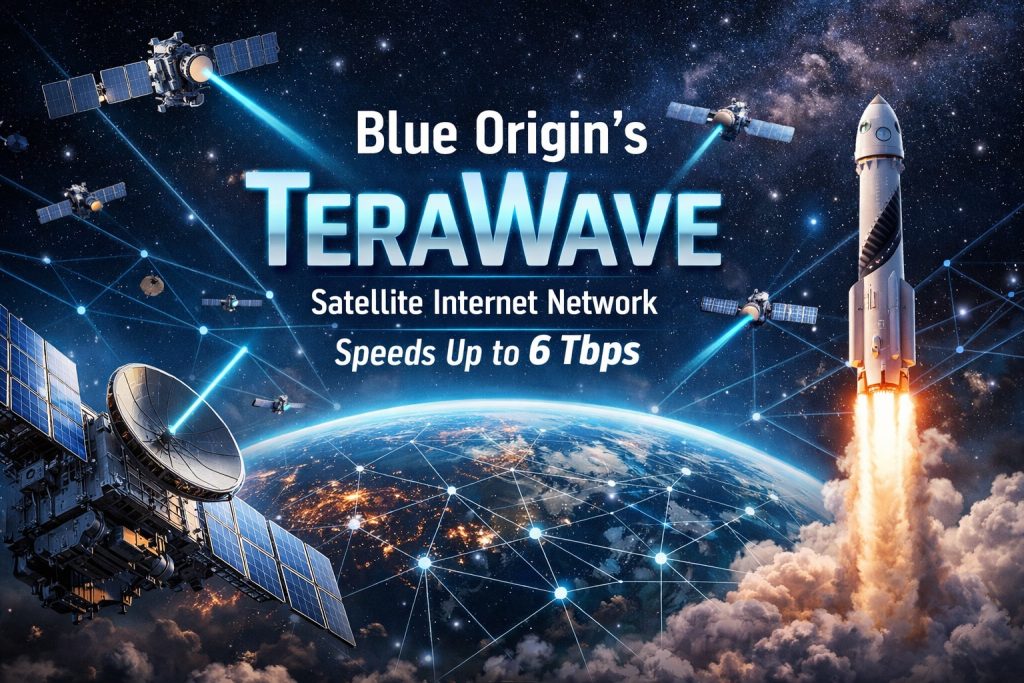
Jeff Bezos’ space company, Blue Origin, has unveiled TeraWave—a new satellite internet network designed to deliver data speeds of up to 6 terabits per second. The network is aimed at enterprise clients, data centers, and government agencies that require high-capacity, reliable connectivity.
The TeraWave constellation will combine 5,280 satellites in low-Earth orbit with 128 satellites in medium-Earth orbit. Blue Origin plans to begin deploying the first satellites in late 2027, though the timeline for completing the full network has not yet been disclosed.
Low-Earth orbit satellites in the system will rely on RF connectivity and support maximum data transfer rates of 144 Gbps. In contrast, the medium-Earth orbit satellites will use optical links capable of reaching the network’s headline speed of 6 Tbps. By comparison, SpaceX’s Starlink currently offers speeds of up to 400 Mbps, with future upgrades expected to reach 1 Gbps.
According to Blue Origin, TeraWave is intended to complement existing network infrastructure by extending connectivity to regions beyond the reach of traditional systems. “TeraWave adds a space-based layer to your existing network infrastructure, providing connectivity to locations unreachable by traditional methods,” the company states on the project’s website.
The announcement follows Amazon’s recent rebranding of its own consumer-focused satellite network, Leo, which will consist of roughly 3,000 low-Earth orbit satellites and provide conventional broadband speeds. While both projects fall under Jeff Bezos’ business empire, Amazon’s Leo and Blue Origin’s TeraWave serve different markets.
Together, the two networks could strengthen competition against SpaceX’s Starlink, currently the dominant satellite internet provider with over 9 million users across consumer, commercial, and government sectors.
Blue Origin says TeraWave was developed to meet growing demand for enterprise-grade internet with higher speeds, symmetrical upload and download performance, increased redundancy, and rapid scalability.
Long known for its suborbital New Shepard missions, Blue Origin has recently expanded its footprint in the commercial space industry. In 2025, the company successfully launched its heavy-lift New Glenn rocket, repeated the mission months later, landed its booster on a second attempt, and delivered its first commercial payload for NASA.
The company plans to launch a robotic lunar lander later this year on New Glenn’s third flight. With TeraWave, Blue Origin now adds satellite manufacturing and network operations to its expanding portfolio.
Source: techcrunch Edited by Bernie