There’s a persistent myth surrounding cryptocurrency: that it’s fully autonomous, self-running, and detached from human oversight. It’s a compelling narrative—machines governing value without intermediaries. But the truth is more grounded, and far more interesting.
Crypto doesn’t run itself. It runs because people operate it.
The Illusion of Automation
At first glance, blockchain networks appear self-sustaining. Transactions execute, balances update, and systems continue without interruption. This creates the impression of a frictionless, automated machine.
But beneath that surface lies a critical layer of human-managed infrastructure.
Networks like Ethereum and Solana depend on a distributed group of operators known as validators. These aren’t passive participants—they are the backbone of the system. Without them, the network doesn’t slow down. It stops.
Validators: The Invisible Operators
A validator isn’t a trader, influencer, or speculator. It’s infrastructure.
Validators run high-performance nodes that:
- Verify transactions
- Propose and validate new blocks
- Enforce consensus rules across the network
This role is essential. Every transaction you send, every smart contract you interact with, passes through this layer of verification.
Without validators, there is no trust. And without trust, there is no blockchain.
Why Incentives Matter
Crypto networks are not powered by goodwill—they are powered by incentives.
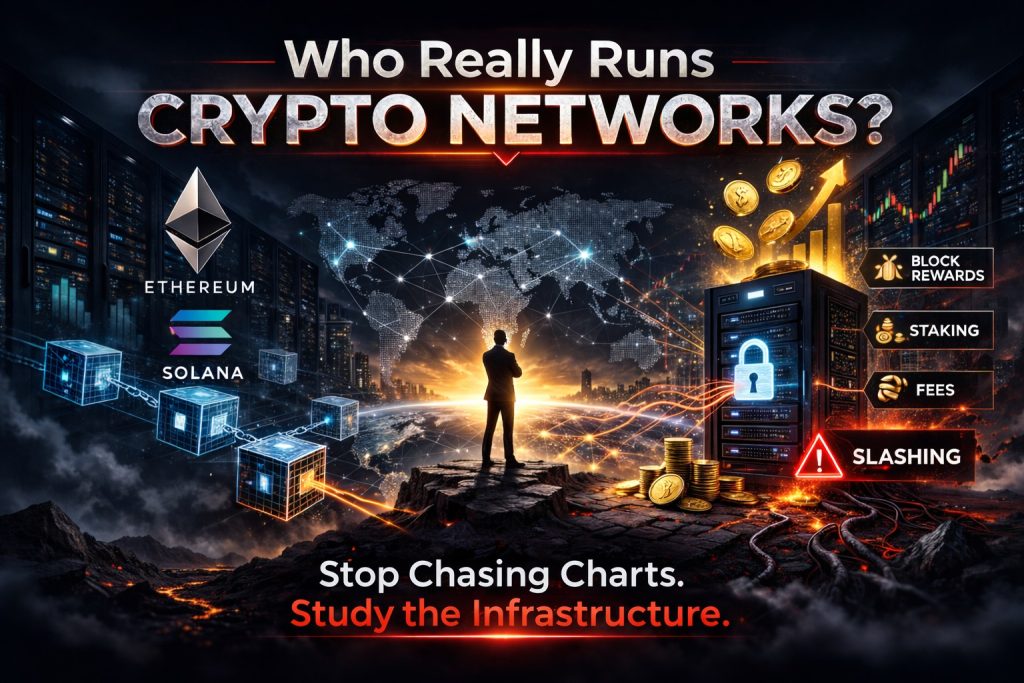
Validators are rewarded for maintaining the network’s integrity. Their earnings typically come from:
- Block rewards
- Transaction fees
- Staking incentives
But this system isn’t one-sided. There are consequences for bad behavior.
If a validator acts dishonestly or fails to perform reliably, they risk penalties—often referred to as “slashing.” This can result in losing a portion of their staked assets. The system is designed to align financial incentives with honest participation.
In simple terms: accuracy pays, misconduct costs.
The Hidden Layer of Crypto
Most people engage with crypto through visible elements—price charts, tokens, and market trends. But that’s only the surface.
The real engine of the ecosystem is largely invisible.
While traders chase volatility, validators maintain order. They ensure that transactions are processed, rules are followed, and the network remains secure.
This distinction matters.
Because if you want to truly understand crypto, looking at price movements isn’t enough. You need to understand the infrastructure that makes those movements possible.
Speculation gets attention. Infrastructure sustains reality.
Crypto networks are not magical systems running in isolation. They are carefully maintained ecosystems powered by individuals and organizations committed to keeping them functional.
So the next time you think about crypto, don’t just ask what’s trending.
Ask who’s running it.