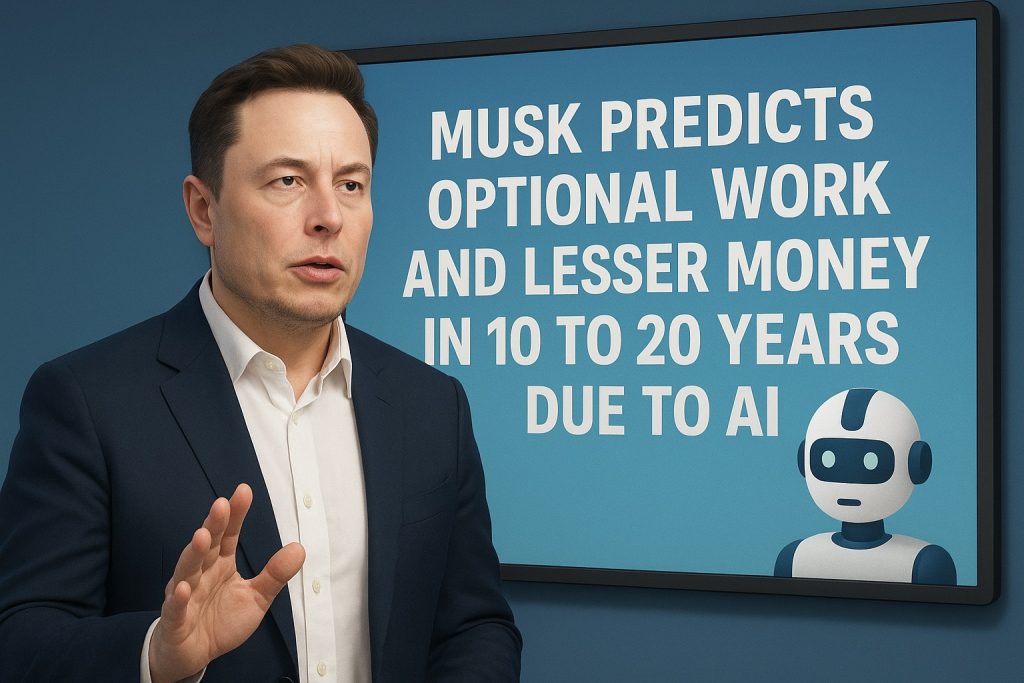
At the U.S.-Saudi Investment Forum in Washington, D.C., Tesla CEO Elon Musk stated that within the next 10 to 20 years, work will become optional. He compared choosing to work to the arduous task of maintaining a vegetable garden.
“My prediction is that work will be optional, much like playing sports or video games,” Musk explained. “If you want to work, it’s similar to deciding whether to buy vegetables from a store or to grow them in your backyard. Growing vegetables at home is more challenging, yet some people still do it because they enjoy the process.”
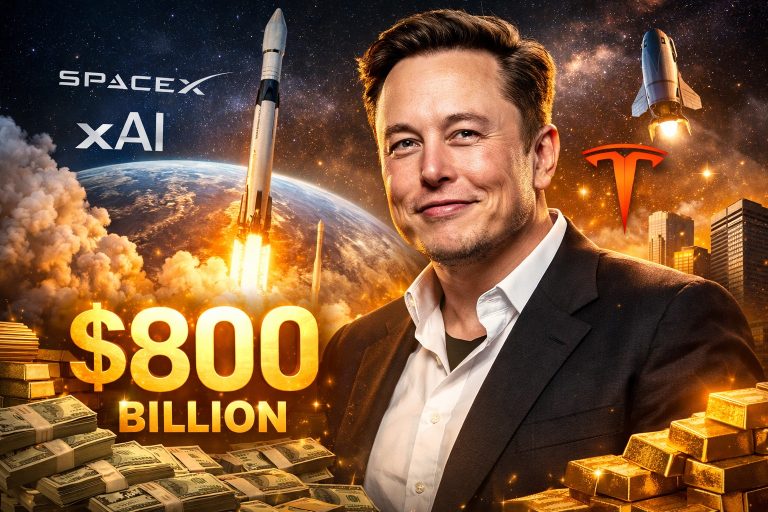
Elon Musk believes that the future of optional work will stem from the integration of millions of robots into the workforce, resulting in a significant boost in productivity. The tech billionaire, with a net worth of approximately $470 billion, is actively working to broaden Tesla’s reach beyond electric vehicles, aiming to unify his extensive business interests under a vision of an AI-driven, robot-powered future. He aspires for 80% of Tesla’s value to come from his Optimus robots, despite ongoing production delays for these humanoid machines.
In contrast, many view this automated future with skepticism, particularly given concerns about AI displacing entry-level jobs, which may be impacting Gen Z’s employment opportunities and stagnant income growth—seemingly a nightmare rather than a dream.
However, Musk envisions a future where money becomes irrelevant in this automated, job-optional landscape. Drawing inspiration from Iain M. Banks’ Culture series of science fiction novels, where money does not exist, Musk stated, “In those books, money doesn’t exist. It’s an interesting concept. My prediction is that if AI and robotics continue to improve, money will no longer be relevant.”
At Viva Technology 2024, he proposed the idea of a “universal high income” to support a world without obligatory work, though he did not elaborate on how this would operate. His reasoning aligns with that of OpenAI CEO Sam Altman, who supports the notion of universal basic income—unconditional payments to individuals, typically provided by the government.
Musk asserted, “There would be no shortage of goods or services,” during last year’s conference.
Is Musk’s Vision of Optional Work Achievable?
According to economists, realizing Musk’s vision for a world of optional work will be challenging. A major concern is whether the technology needed to automate jobs will be both accessible and affordable over the coming decades. While the cost of AI is decreasing, robotics remain expensive, complicating widespread adoption. Ioana Marinescu, an economist and associate professor of public policy at the University of Pennsylvania, noted that her recent research with colleague Konrad Kording highlighted this issue. For instance, AI expense management platform Ramp reported that companies paid $2.50 per million tokens for AI services in April, down from $10 just a year prior.
“We’ve been working on machine-making since the Industrial Revolution,” Marinescu stated. “Economically, we often encounter diminishing returns in such endeavors, particularly as technological progress becomes harder over time.”
While she acknowledges the rapid advancements in AI—particularly large language models that can support many white-collar jobs—Marinescu points out that physical machines required for automation are not only costly but also highly specialized, which hinders their implementation in the workplace.
Marinescu shares Musk’s belief in a future dominated by full-scale automation but is skeptical about the timeline. She highlights that AI adoption in the workplace has not progressed as quickly as expected, despite a wave of recent tech-related layoffs. A report from the Yale Budget Lab in October indicated that since the public release of ChatGPT in November 2022, the broader labor market hasn’t experienced significant disruption from AI automation.
Additionally, there are serious considerations regarding the impact of these changes on the millions—possibly billions—of jobless individuals. Even with a growing recognition of the need for universal basic income, the political will to implement such measures remains uncertain. Samuel Solomon, an assistant professor of labor economics at Temple University, emphasized that the political framework supporting a transformed labor force will be just as crucial as the technology itself.
“AI has already generated significant wealth and will continue to do so,” Solomon stated. “However, a crucial question remains: Will this prosperity be inclusive? Will it lead to inclusive growth that benefits everyone?”
Current systems seem to be widening the divide between the wealthy and the less fortunate during this AI-driven industrial revolution, starting with Musk’s $1 trillion pay package. The growing AI bubble has highlighted societal class disparities, as earnings expectations for the “Magnificent Seven” rise due to the AI boom, while projections for the remaining S&P 493 companies decline, according to Torsten Slok, chief economist at Apollo Global Management.
“Spending by affluent Americans, fueled by their booming stock portfolios, is currently the primary driver of economic growth,” Slok noted in a recent blog post.
Existential Changes
Navigating the complexities of a work-optional world is one challenge; determining whether this is something that society truly desires is another.
“If the economic value of labor diminishes to the point where it’s no longer meaningful, we’ll need to reconsider the structure of our society,” said Anton Korinek, professor and faculty director of the Economics of Transformative AI Initiative at the University of Virginia.
Korinek referenced research, including a pivotal 1938 Harvard University study, which found that people derive satisfaction from meaningful relationships. Currently, many of these connections are formed through work. In Musk’s envisioned future, succeeding generations will have to redefine how they cultivate meaningful relationships.
At Viva Technology last year, Musk shared his perspective on the existential future of humanity.
“The core question will be one of meaning: If computers and robots can outperform you in every task, does your life still hold meaning?” he remarked. “I believe there may still be a role for humans in this scenario, as we could impart meaning to AI.”