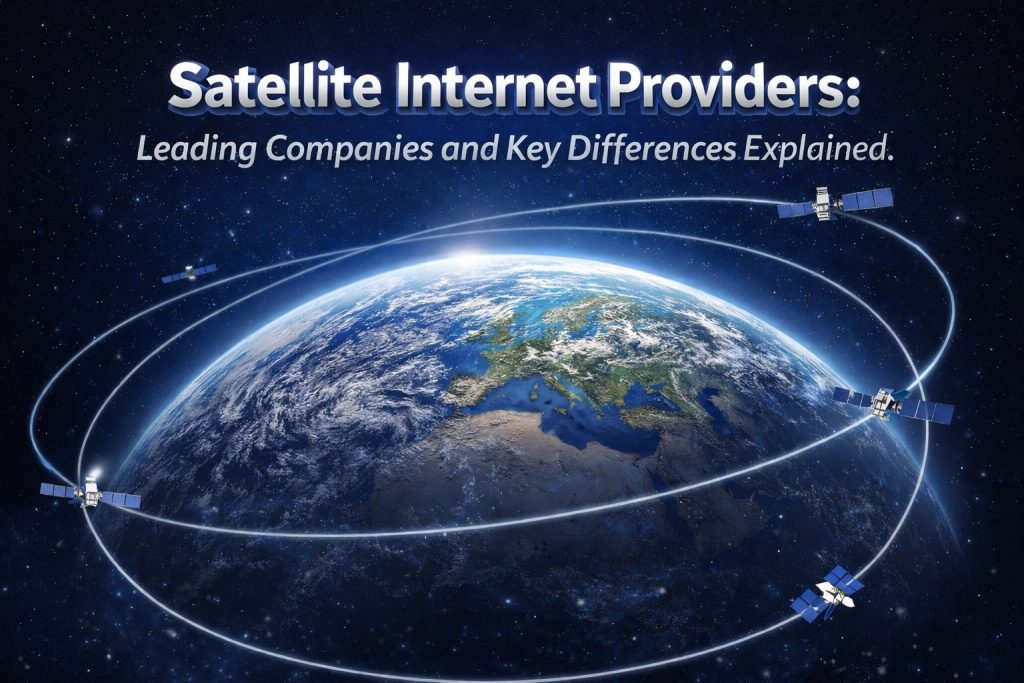
Satellite internet is rapidly becoming a mainstream way to connect people and businesses across the globe — especially in remote or underserved areas where traditional fiber and cellular networks struggle to reach. Unlike terrestrial broadband, satellite internet uses networks of satellites orbiting Earth to beam connectivity directly to users’ homes, offices, ships, and even airplanes. Below, we break down the major players in this fast-evolving space and what distinguishes them.
📡 1. Starlink (SpaceX)
Overview:
Starlink, operated by SpaceX, currently leads the satellite broadband market with one of the largest low-Earth-orbit (LEO) constellations in operation. It offers global coverage and has millions of subscribers worldwide.
What Sets It Apart:
- Low latency and high speeds: Because its satellites orbit closer to Earth than traditional systems, Starlink reduces signal delay, making it better for video calls, gaming, and streaming.
- Global reach: Service is available in more countries than most competitors.
- Consumer focus: Starlink sells directly to households as well as to businesses and government clients.
🚀 2. Amazon Leo (formerly Project Kuiper)
Overview:
Amazon’s satellite internet initiative rebranded to Amazon Leo and aims to deploy thousands of satellites from 2026 onward to offer global broadband.
What Sets It Apart:
- Integration with AWS: Amazon could leverage cloud services and enterprise partnerships, especially for business customers.
- Targeting both consumers and businesses: While still rolling out, Leo promises speeds competitive with Starlink and aims for wide coverage once fully deployed.
🛰️ 3. OneWeb / Eutelsat OneWeb
Overview:
OneWeb — now part of the Eutelsat Group — operates a LEO satellite constellation focused on enterprise, government, and telecom partners. It’s one of the only other fully operational LEO broadband networks besides Starlink.
What Sets It Apart:
- Enterprise and wholesale focus: OneWeb typically doesn’t sell directly to consumers; instead, it partners with telecom companies and large organizations for connectivity services.
- Government backing: Several European governments support the network as part of regional broadband infrastructure.
🌍 4. Viasat
Overview:
An established satellite internet provider using geostationary satellites (which orbit much higher than LEO systems). Viasat delivers broadband across large regions, especially in rural and remote areas.
What Sets It Apart:
- Wide coverage: GEO satellites provide broad beams covering large territories.
- Consistent service for basic needs: Speeds generally suit web browsing, email, and video streaming at standard resolutions, though with higher latency than LEO systems.
📶 5. HughesNet
Overview:
Another legacy provider using geostationary satellites, HughesNet has been a popular choice in North America and parts of Latin America for many years.
What Sets It Apart:
- Budget-friendly: Often a more affordable option for basic satellite connectivity.
- Data-cap plans: Many plans include data limits and throttling after thresholds, which can impact heavy internet users.
🌐 6. Other Notable Networks
While not yet consumer household names, several other satellite systems are growing or targeting niche markets:
- Telesat Lightspeed: LEO constellation focusing on enterprise and specialized connectivity.
- AST SpaceMobile & Lynk Global: Aim to connect mobile phones directly via satellite.
- Regional players: Operators like Kacific and others deliver broadband to specific geographic regions such as the Pacific Islands and Asia.
📊 Key Differences Between Providers
| Provider | Orbit Type | Target Audience | Coverage | Typical Strength |
|---|---|---|---|---|
| Starlink | LEO | Broad (consumer/business) | Global | Low latency, high speed |
| Amazon Leo | LEO | Consumer & enterprise | Future global | AWS integration potential |
| OneWeb/Eutelsat | LEO | Telecom & enterprise | Large/Global | Partner-focused services |
| Viasat | GEO | Consumers & enterprises | Wide regionally | Broad coverage |
| HughesNet | GEO | Consumers | Americas focus | Affordability in rural |
Orbit Matters
- LEO satellites orbit closer to Earth → lower latency (better responsiveness) and generally faster speeds.
- GEO satellites orbit much higher → broader footprint but higher latency, affecting real-time applications like gaming or video conferencing.
Satellite internet is no longer a niche connecting just ships or rural towns — it’s a growing global network transforming how people access the web everywhere. Whether you’re a tech enthusiast tracking the space race or a consumer seeking reliable broadband off the beaten path, understanding the differences between providers will help you choose the right fit. As new networks like Amazon Leo and Blue Origin’s TeraWave enter the field, competition is poised to push speeds higher and costs lower — a win for users everywhere.