Some Bitcoin enthusiasts believe devices like Bitwater could help decentralize the cryptocurrency network.
Heatbit has spent several years developing space heaters and air purifiers that mine Bitcoin while producing heat. The company has received a CES Innovation Award, and its products have been reviewed by publications such as Wired and The New York Times. Now, the Delaware-based company, founded around 2020 by Alex Busarov, is bringing its concept to household water heating with a product called Bitwater.
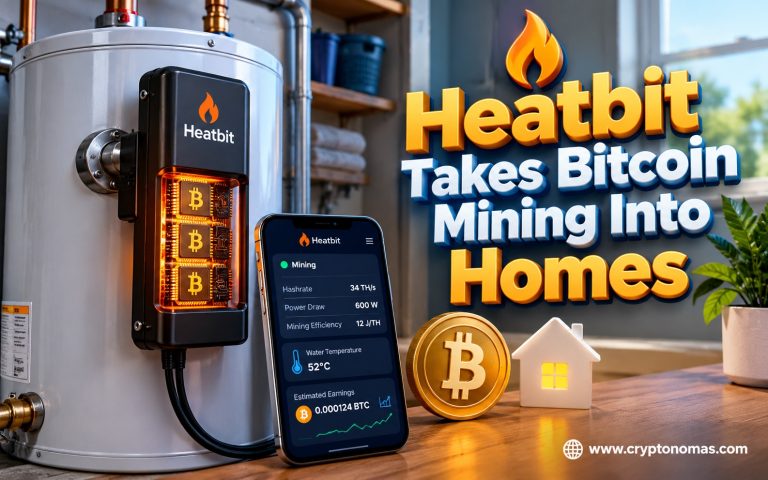
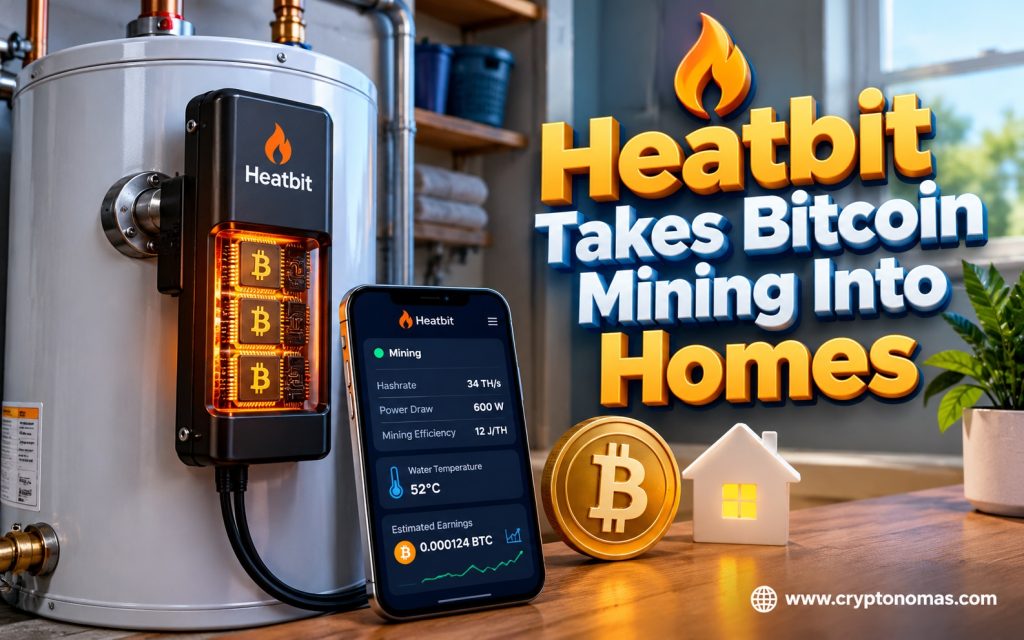
Bitwater is designed as a replacement heating element for conventional electric water tanks. Rather than relying solely on a traditional resistance wire, the device uses Bitcoin-mining chips that produce heat while contributing computing power to the Bitcoin network.
According to Heatbit, Bitwater replaces the heating wire found in a standard electric water-heater element with 20 Bitmain BM1370 mining chips. The company claims the device can deliver up to 34 terahashes per second (TH/s), consume up to 600 watts of power, and achieve mining efficiency starting at 12 joules per terahash. Because the surrounding tank water cools the chips directly, the system does not require noisy cooling fans.
Heatbit says Bitwater is compatible with many 30- to 80-gallon electric water heaters in the United States and Canada that feature a compatible one-inch screw-in element port. Supported brands reportedly include A. O. Smith, Rheem, Bradford White, Whirlpool, and GE.
A companion app allows owners to monitor water temperature, mining hashrate, and earnings. Bitcoin generated through pooled or solo mining is sent to a wallet address controlled by the user. Heatbit has announced refundable preorders for its first production run at $899, with shipments expected to begin in the first quarter of 2027.
Does Bitwater Make Financial Sense?
The central question is whether Bitwater can provide the same hot-water service as a conventional heating element while lowering a household’s overall costs over time.
In its Bitwater announcement on X, Heatbit said it had tested the device during winter in households of four and five people in New York and Florida. However, the company did not publish detailed findings from those trials. In a separate post on X. Heatbit claimed that replacing a conventional heating element with Bitwater would not increase water-heating costs.
Both traditional resistance heaters and Bitcoin-mining chips convert almost all the electricity they consume into heat. However, this similarity alone does not guarantee that Bitwater will save consumers money. Its financial performance will depend on several factors, including the purchase price, household hot-water usage, operating settings, uptime, electricity rates, hardware lifespan, and Bitcoin mining profitability.
Previous reviews of Heatbit’s space heaters by Wired and The New York Times questioned whether the mining features could offset the products’ higher upfront costs. In his review for Wired, Matthew Korfhage highlighted the challenge of recovering the additional investment when compared with cheaper heating alternatives.
The same concern applies to Bitwater. A conventional replacement water-heater element can cost less than $30, meaning buyers could pay roughly $870 more for Bitwater. To justify that premium, the device would need to generate enough mining income to recover the difference and potentially deliver additional savings over its useful life.
Heatbit has not released an official Bitcoin earnings forecast of its own. However, the company shared an estimate generated by xAI’s Grok suggesting potential earnings of approximately $1 to $1.25 per day. Assuming 80% uptime, that would amount to around $292 to $365 in gross mining revenue annually. These figures reflect a particular mining-market snapshot and should not be treated as guaranteed or stable returns.
Conventional water-heater elements often last approximately six to ten years. Whether Bitwater can deliver a worthwhile return over a comparable period remains uncertain. At the estimated mining rates, recovering an $899 purchase price in roughly three years might appear possible under favorable conditions. However, that calculation assumes mining revenue remains relatively consistent, which cannot be guaranteed.
Bitcoin mining profitability changes with the price of Bitcoin, network difficulty, block rewards, and competition among miners. As these conditions shift, Bitwater’s daily earnings could rise or fall substantially. Hardware reliability and the cost of repairs or replacement would also affect its long-term value.
Using mining hardware to produce useful heat is not a new concept. Bitcoin mining companies and independent enthusiasts have explored heat recovery in homes, commercial buildings, and greenhouses for years.
MARA Holdings, formerly known as Marathon Digital Holdings, has introduced two Bitcoin-mining heat reuse projects in Finland. These initiatives supply heat to district-heating networks serving communities with nearly 80,000 residents.
Such projects demonstrate how mining’s electricity consumption can be put to another use. However, the financial and environmental benefits depend on whether the heat is needed when it is produced, the costs of delivering it, and the heating alternatives available.
Could Bitwater Also Help Decentralize Bitcoin?
Beyond its potential use in household heating, Bitwater raises another question: could devices like this help distribute Bitcoin mining across more independent participants?
Heatbit and other proponents argue that household mining devices could spread hashrate across individual homes rather than leaving a disproportionate share of mining power in the hands of large mining companies.
Mining concentration is a concern for Bitcoin because a single entity or coordinated group controlling a majority of the network’s mining power could potentially reorganize recent blocks or censor transactions. Such attacks are commonly associated with the 51% attack model, although their feasibility and consequences depend on the circumstances.
There are also broader debates about the legal responsibilities of Bitcoin infrastructure operators. Following the prosecution of privacy-focused Samourai Wallet co-founder Keonne Rodriguez, who is serving a five-year prison sentence in connection with his work on the wallet, some privacy advocates have raised concerns about how authorities might interpret the roles of different participants in the cryptocurrency ecosystem.
One argument, advanced by Rodriguez, is that extending the government’s reasoning in the Samourai Wallet case could eventually lead to greater scrutiny of miners because they choose which transactions to include in blocks. This remains a contested legal and policy argument, rather than an established conclusion that Bitcoin miners generally qualify as money transmitters.
Ultimately, Bitwater combines two established ideas: using electricity-intensive computing to generate useful heat and distributing Bitcoin mining beyond large industrial facilities. Whether it becomes an attractive option for homeowners will depend on real-world performance, mining revenue, reliability, and the ability to compete with inexpensive conventional heating elements.
For now, Bitwater presents an intriguing experiment in household Bitcoin mining, but its $899 price tag means buyers will need convincing evidence of long-term value before the device can be considered a practical money-saving alternative.
However, Bitwater’s ability to improve Bitcoin’s decentralization will depend on how much computing power household miners contribute compared with the network as a whole. Heatbit estimates that homes consume approximately 300 terawatt-hours of electricity annually to heat water, while the entire Bitcoin network uses around 170 terawatt-hours. Meanwhile, Bitcoin’s hashrate growth has slowed over the past year or so as major mining companies have redirected some of their infrastructure toward artificial intelligence (AI) computing.
Bitcoin Mining Faces Another Challenge
Bitcoin’s energy consumption has faced years of criticism from environmental advocates, largely because increased electricity demand can lead power plants to burn more fossil fuels. These concerns have also sparked disagreements within the cryptocurrency industry.
Ripple co-founder Chris Larsen, for example, committed millions of dollars to a Greenpeace campaign aimed at encouraging Bitcoin developers to abandon the proof-of-work system. Many Bitcoin supporters criticized the initiative, viewing it as an attack on Bitcoin from a cryptocurrency project they consider more centralized and less credible.
In recent years, however, discussions about Bitcoin’s environmental impact have become more complex. Research published in ACS Sustainable Chemistry & Engineering and the Journal of Cleaner Production has examined how Bitcoin mining could help fund renewable-energy projects and improve the financial viability of reducing methane emissions from landfills.
Nevertheless, concerns about mining’s environmental footprint remain. A 2025 study published in Nature Communications estimated that, between mid-2022 and mid-2023, electricity consumption by 34 large Bitcoin mines in the United States prompted additional power generation from plants that relied on fossil fuels for approximately 85% of their electricity production. At the same time, media analysis by Perception suggested that negative environmental coverage of Bitcoin declined in 2025.
Devices such as Bitwater could offer another approach to addressing these concerns. Because Bitcoin-mining chips generate heat while performing computational work, integrating them into household water heaters could allow electricity already needed for heating to serve an additional purpose. If the mining function replaces conventional heating energy without increasing overall electricity consumption, it could make better use of the energy households would otherwise consume.
However, this benefit depends on how the devices are operated and what heating systems they replace. Critics may still argue that Bitcoin mining consumes valuable energy that could be directed toward other uses, particularly when the electricity comes from fossil-fuel sources.
Ultimately, the impact of Bitwater and similar products will depend on actual adoption rates, measured energy consumption, long-term mining profitability, and the amount of hashrate transferred to individual households. Until these factors can be evaluated using real-world data, it remains uncertain whether household mining devices will significantly improve Bitcoin’s decentralization or reduce the industry’s overall environmental footprint.
Source: gizmodo.com Edited by Bernie